

Char Dham Yatra (Uttarakhand)
Uttarakhand, IndiaSpiritual Journey
The Char Dham Yatra of Uttarakhand — also called the Chota Char Dham, to distinguish it from the all-India Char Dham of Badrinath, Dwarka, Puri and Rameswaram — links four Himalayan shrines: Yamunotri, Gangotri, Kedarnath and Badrinath. Two of them stand at the sources of India''s two most sacred rivers. All four sit above 3,000 metres, close under the snow line, and all four are closed and empty through the winter. The shrines open around Akshaya Tritiya in late April or May and close around Bhai Dooj, just after Diwali. In between, the deities of Kedarnath and Badrinath are carried down to their winter seats at Ukhimath and Joshimath, and the doors are shut against the snow. That opening and closing is not a formality — it is why the yatra has a season at all, and why the road is so crowded inside it. Pilgrims travel the four in a fixed clockwise order — Yamunotri, then Gangotri, then Kedarnath, then Badrinath — a sequence that has been followed for centuries and that still shapes how the roads, the halts and the towns along the way are organised.
May to October
Pleasant weather and smooth travel.

10 to 12 days
Ideal duration for a complete yatra.
How hard it is
Demanding — long mountain roads; two shrines reached on foot above 3,000 m
The Char Dham route


- 1Yamunotri · UttarakhandSource shrine of the Yamuna; first dham of the circuit.
- 2Gangotri · UttarakhandShrine at the origin of the Ganga; second dham.
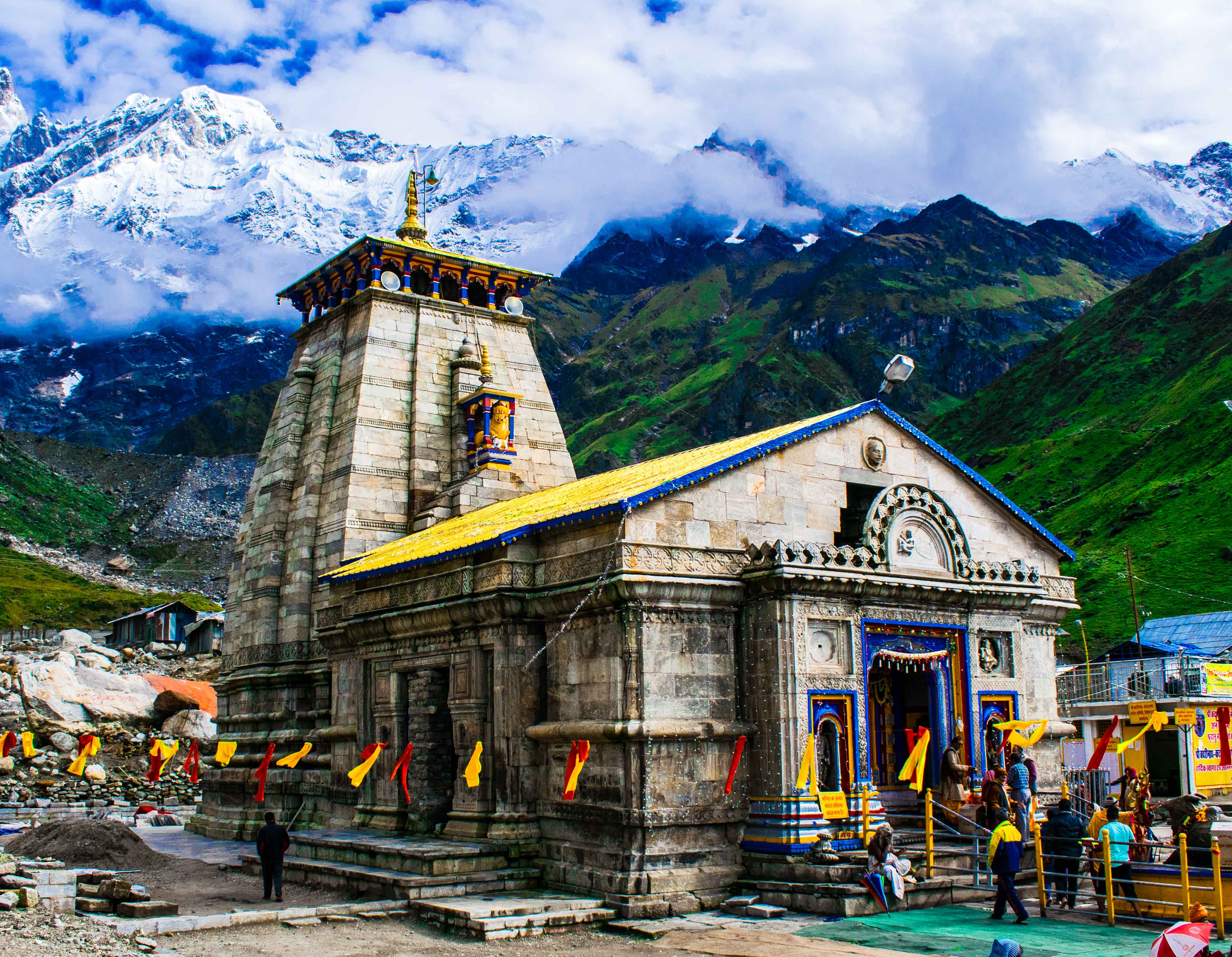
- 3Kedarnath · UttarakhandHigh-Himalayan Jyotirlinga of Shiva; third dham.
- 4Badrinath · UttarakhandVishnu shrine and the final dham of the circuit.
Temple elevations above sea level.
Travel Tip
Book accommodation well in advance, and carry light woollens even in summer — every one of the four shrines sits above 3,000 m.
Char Dham Yatra (Uttarakhand)Checked
Pilgrimage route
The Char Dham Yatra of Uttarakhand — also called the Chota Char Dham, to distinguish it from the all-India Char Dham of Badrinath, Dwarka, Puri and Rameswaram — links four Himalaya…
Best season
May to October
Pleasant weather and smooth travel.
Duration
10 to 12 days
Ideal duration for a complete yatra.
How hard it is
Demanding — long mountain roads; two shrines reached on foot above 3,000 m
Before you go
Let me tell you the thing I say to every traveller on the first morning, before we have driven a single kilometre.
The Char Dham is not four temples. It is one journey with four pauses in it.
You will spend far more hours on mountain road than you will ever spend inside a sanctum. Ten, eleven days on this yatra, and the actual darshan at all four shrines put together might come to forty minutes. So if you have come to collect four temples, you will come home tired and a little disappointed, and you will not know why.
Come instead for the road. For the Ganga running grey-green and furious beside you all the way up from Rishikesh. For the moment at Devprayag where two rivers of different colours meet and refuse to mix for a while. For the deodar forests above Uttarkashi, for the first sight of snow on Bandarpunch. The pilgrims who understand this — that the walking and the waiting and the road are the yatra, not the queue at the end of it — those are the ones who come down changed.
The mountain will set the pace, not your itinerary. Learn that early and the whole trip becomes easier.
Along the way
The shrines and the country you cross to reach them.



The journey
What this journey actually is
The Char Dham Yatra of Uttarakhand — also called the Chota Char Dham, to distinguish it from the all-India Char Dham of Badrinath, Dwarka, Puri and Rameswaram — links four Himalayan shrines: Yamunotri, Gangotri, Kedarnath and Badrinath. Two of them stand at the sources of India''s two most sacred rivers. All four sit above 3,000 metres, close under the snow line, and all four are closed and empty through the winter.
The shrines open around Akshaya Tritiya in late April or May and close around Bhai Dooj, just after Diwali. In between, the deities of Kedarnath and Badrinath are carried down to their winter seats at Ukhimath and Joshimath, and the doors are shut against the snow. That opening and closing is not a formality — it is why the yatra has a season at all, and why the road is so crowded inside it.
Pilgrims travel the four in a fixed clockwise order — Yamunotri, then Gangotri, then Kedarnath, then Badrinath — a sequence that has been followed for centuries and that still shapes how the roads, the halts and the towns along the way are organised.
Why pilgrims come
This is the Himalayan heart of Hindu pilgrimage, and each dham answers to a different god and a different idea.
Yamunotri is Yamuna — daughter of the sun, sister of Yama who is death itself. The old belief is that a bath in her waters spares you a painful end. Gangotri is Ganga, brought down from heaven by Bhagirath''s penance and broken in Shiva''s hair so that her fall would not shatter the earth; the actual glacier snout at Gaumukh lies a further eighteen kilometres up the valley, and the temple stands where she is first properly worshipped.
Kedarnath is Shiva, and one of the twelve Jyotirlingas — the self-manifest lingas of light. The story here is of Shiva fleeing the Pandavas in the form of a bull and diving into the ground, leaving his hump behind. That is what the sanctum holds: not a carved image but a rough conical rock. Badrinath is Vishnu, seated in meditation, sheltered by Lakshmi in the form of a badri berry tree. Adi Shankaracharya is held to have re-established the shrine in the eighth century, and it is counted among both the Chota Char Dham and the older all-India Char Dham.
Taken together, the four bind the two great streams of Hindu devotion — Shaiva and Vaishnava — into a single circuit, with the two river-goddesses at its head.
What a day looks like
A day on the Char Dham has a shape, and it is not the shape of a holiday.
You will be up at four or half past. This is not devotion, it is traffic — the mountain road is single-lane in places, the convoys build up by seven, and the only way to get a clear run is to be on it before the light. Tea in the dark, bags in the vehicle, gone.
The driving happens through the morning. Six, seven hours is normal, and much of it is slow: hairpins, roadwork, an army convoy coming the other way, a herd of goats that has decided otherwise. You will stop at a dhaba around nine for parathas. You will stop again because someone needs to. This is fine. Do not fight it.
You arrive at the halt town in the afternoon, and this is when the yatra actually happens — the walk up, or the walk to the temple, and then the wait in line. Afternoons and evenings are when the shrines fill.
At the temples themselves, mornings and evenings carry the aarti, and the aarti is the thing to be present for. The lamps, the bells, the sound of two hundred people saying the same words in a stone room at four thousand metres — that is what you will remember, more than the six seconds you get in front of the deity.
And then early to bed, in a room that is colder than you expected, because tomorrow starts at four again.
Ten days of this is genuinely tiring. I say that not to put you off but so that you plan for it: if you can, put a rest day in the middle, at Uttarkashi or Guptkashi. The pilgrims who do are the ones still smiling at Badrinath.
Getting ready
Getting there, and getting around
Everything starts from Haridwar or Rishikesh. Both sit on the Ganga where the plains end, both are on the railway, and both are where the mountain road begins. Dehradun''s airport at Jolly Grant is about an hour from Rishikesh, so flying in and starting the same afternoon is possible — though I would not recommend it. Give yourself a night at the bottom.
From there it is one long, winding, single-carriageway climb, and the four dhams are strung along it roughly in this shape:
Rishikesh to Barkot, the base for Yamunotri — a full day. Yamunotri itself is not reached by road. You drive to Janki Chatti and then walk about six kilometres up. Ponies and palanquins operate on this stretch for those who cannot.
Barkot across to Uttarkashi, then up to Gangotri — again a full day of driving, though this one ends kindly: the road goes right into Gangotri town and the temple is a few minutes'' walk from where you stop.
Gangotri back down and across to Guptkashi or Sonprayag for Kedarnath — the longest transfer of the whole yatra. Kedarnath is the hard one. Vehicles stop at Sonprayag; you shuttle to Gaurikund and then it is roughly sixteen kilometres on foot, climbing steadily. Ponies, palanquins and porters work this route, and helicopter services operate in season from the Phata, Sersi and Guptkashi helipads, weather permitting. Weather permitting is doing a lot of work in that sentence.
Kedarnath to Badrinath, via Joshimath — and Badrinath is the gentlest of the four to arrive at. The road ends at the town, the temple is right there in front of you, painted and unmistakable.
Then the long descent back to Rishikesh.
Two things about this road that nobody tells first-timers. It closes at night — landslide-prone stretches are gated after dark, and drivers will not run them, and you should not want them to. And it is a Himalayan road in monsoon country: a rock comes down, a stretch washes out, and everything stops for some hours. Build slack into your plan. A yatra with no spare days is a yatra that will break.
Permits and registration
Registration is mandatory for all four dhams. Every pilgrim and every vehicle must be registered on the Uttarakhand government's official Yatra registration portal before travelling; you are issued a registration letter with a QR code that is checked at points along the road. Carry it, printed or on your phone.
How to prepare
Start walking, six weeks out
This is the single piece of advice that changes people''s yatra. Not the gear, not the itinerary — the legs. Kedarnath is sixteen kilometres uphill and Yamunotri is six, and both are at an altitude where your lungs get less than they are used to. Walk an hour a day, and put some stairs in it. If you can climb ten flights without stopping to think about it, you will be fine.
Understand the altitude before you meet it
All four dhams are above 3,000 metres. That is high enough for headaches, poor sleep, breathlessness on stairs and a strange loss of appetite — and for a small number of people, something more serious. The protection is simple and unglamorous: go up slowly, sleep low where you can, drink far more water than feels necessary, and do not drink alcohol on the way up. If a headache will not lift, if you are unsteady, or if you are breathless while sitting still, go down. Altitude sickness does not negotiate and it does not care about your schedule. Going down is the cure.
Get a doctor to look at you first
if you are over sixty, or if you have heart trouble, asthma, uncontrolled blood pressure or diabetes. Uttarakhand runs health screening points along the yatra route and posts a health advisory each season. Take it seriously; it exists because people have died on this road who did not need to.
Register before you leave
It is mandatory, for you and for your vehicle, on the Uttarakhand government''s official portal. You are issued a registration letter with a QR code and it is checked on the way up. Do this at home, in your own time, with your ID to hand — not at a counter in Haridwar with a queue behind you.
Carry your medicines, and carry more than you need
Whatever you take daily, bring the whole trip''s supply plus a week. Pharmacies thin out fast above Rishikesh, and the one thing you cannot buy at 3,500 metres is the tablet you left at home. Keep them in your day bag, not the luggage on the roof.
Plan fewer days than you have
Ten to twelve days is the honest window for all four at a humane pace. If you have eight, do two dhams properly rather than four badly. The mountain will take days from you — a landslide, a road closure, weather that grounds the helicopters — and you want those days to come out of your slack, not out of your yatra.
Bring your own faith and leave your certainty at home
You will meet sadhus, families carrying an elderly parent in a palanquin, people who have saved for years for this. The tone of the yatra is patient and generous. Match it.
What to pack
Pack for a mountain, not for a temple. It will be twenty-five degrees in Rishikesh and near freezing at Kedarnath at dawn, on the same trip.
Layers, not one big coat
Thermals for the top and bottom, two fleeces or warm mid-layers, and a windproof outer that also keeps rain off. Layers let you shed heat on the climb and put it all back on the moment you stop sweating — which is exactly when mountain cold gets you.
Rain gear you can walk in
A poncho or a proper rain jacket, and a rain cover for your bag. Umbrellas are useless in Himalayan wind. Assume you will be rained on even outside the monsoon.
Shoes that are already broken in
Trekking shoes with real grip and ankle support, worn for weeks before you leave. New shoes on the Kedarnath climb is the most common self-inflicted injury on this yatra. Bring a second pair of light shoes or slippers for the evenings, and enough socks that you always have a dry pair — wet feet at altitude are miserable.
A walking stick
Buy one at the base of the climb if you did not bring poles. On the descent from Kedarnath, when your knees are shouting, you will understand.
Warm hat, gloves, and something for your neck
Most of your heat leaves through your head. And sunglasses with real UV protection plus high-factor sunscreen — thin mountain air burns you far faster than the plains, even on a grey day, and there is snow around to bounce it back at you.
A torch or headtorch
Power fails often up there. Pre-dawn starts are the norm. A headtorch leaves your hands free on a dark path.
Your documents together in a waterproof pouch
— the Yatra registration QR, photo ID, medical prescriptions, emergency contacts written on paper. Paper works when the phone is dead and the signal is gone, and both of those will happen.
A small day bag
with water, dry fruit or biscuits, medicines, torch and rain layer. The big luggage stays with the vehicle; this is what climbs with you. Keep it light — every extra kilo is a kilo you carry sixteen kilometres uphill.
A reusable water bottle
Uttarakhand restricts single-use plastic on the yatra routes, refill points exist along the way, and the mountain does not need any more bottles than it already has.
Leave behind
heavy leather goods (many sanctums do not allow leather inside), jewellery you would grieve for, and anything you are carrying only because it seemed like a good idea. You will be moving this bag every single day.
On the ground
How to behave at the shrines
Nobody will scold you for getting this wrong. But you will feel better, and the people around you will feel better, if you get it right.
Shoes come off well before the temple
There is a stand, there is a boy who will watch them, and there is always a crowd of footwear at the boundary — that is your line. Socks are usually fine to keep on, and at Kedarnath in the cold morning you will be glad of them.
Cover your shoulders and your knees
Nobody is checking with a ruler, but this is a working shrine, not a monument. Simple, modest, unfussy. And practical: it is cold.
Leather is a problem
Belts, wallets, bags — many Hindu sanctums do not permit leather past a certain point. It is easier to just not carry it than to argue at the gate.
Photography stops at the sanctum
Outside the temple, in the courtyard, on the road — photograph freely, it is a beautiful yatra. Inside, where the deity is, put the phone away. There are usually signs. Where there are not, look at what everyone else is doing. And never photograph a person at prayer without asking; a smile and a raised camera is enough of a question.
Move clockwise
Circumambulation — parikrama or pradakshina — goes clockwise around the sanctum, so keep your right shoulder to the shrine. Just follow the flow of people; you will not get it wrong.
In the queue, do not push and do not be surprised at being pushed
Indian temple queues compress. It is not aggression. Hold your place, keep your bag in front of you, keep an eye on children, and understand that your time before the deity will be seconds, not minutes — a priest or a guard will move you along, and that is normal even for lifelong devotees. Say what you came to say quickly, or say it standing outside where nobody is moving you.
Take prasad with your right hand,
and eat it or carry it respectfully — do not bin it in front of the temple. The left hand is traditionally considered unclean for this. Same with giving or receiving anything.
Do not touch the deity, the priest, or ritual objects
unless you are invited to. Do not step over someone who is sitting or prostrate on the floor.
At Yamunotri, there is a hot spring called Surya Kund
where pilgrims cook rice tied in cloth and carry it away as prasad. At Badrinath, most pilgrims bathe in the Tapt Kund hot spring below the temple before darshan. Both are genuinely worth doing and both are open to visitors — watch how it is done first, then join in.
If you are not Hindu, you are welcome at all four,
and nobody will interrogate you. Behave as the person next to you behaves and you will be fine. Some temples elsewhere in India do restrict entry to Hindus; these four do not, though sanctum access can be limited during rituals for everyone.
Silence is a kindness
These are small stone rooms holding a lot of feeling. Someone near you has waited a long time and travelled a hard road to stand where they are standing.
If it is your first time
Here are the mistakes I see every season, from people who did everything else right.
Trying to do all four in a week
It is the commonest error and it ruins trips. The distances look small on a map and they are not — this is Himalayan road, where sixty kilometres can take four hours. Ten to twelve days for four dhams. If your leave does not stretch that far, do Kedarnath and Badrinath properly and come back another year for the other two. Two dhams done well beats four done in a blur.
Fixing the dates and starting the training the week before
Your legs are the equipment that matters. See the preparation notes — six weeks of walking transforms this yatra.
Treating the helicopter as a guarantee
Services to Kedarnath do operate in season, and they are a genuine help for those who cannot walk. But cloud sits in that valley for days at a time and nothing flies. Have a plan that works on foot, or a plan that works if you do not reach Kedarnath at all.
Underestimating the cold because it is May
Rishikesh in May is hot. Kedarnath at five in the morning in May is near freezing, with wind. Every year people arrive in a cotton kurta and shiver through the aarti they came for.
Ignoring a headache
At 3,500 metres a headache that will not lift is information, not an inconvenience. Descend, rest, drink water. There is no prize for pushing through, and the shrine will be there next year.
Arriving without the registration
It is mandatory, it is checked on the road, and doing it in a hurry at a counter with a queue behind you is a bad start to a pilgrimage.
Rushing the darshan and missing the aarti
New pilgrims fixate on the moment in front of the deity, which lasts seconds and is over before you have settled. The aarti — morning or evening, lamps and bells and a room full of voices — lasts much longer and is where the feeling actually lives. Plan your day around the aarti, not the queue.
Not talking to anyone
The pilgrims around you are half the yatra. The family from Coimbatore who have done this three times. The porter who has climbed to Kedarnath more times this season than you have climbed stairs this year. The old woman being carried up who will tell you exactly what she came for. Ask. They will tell you, and it will stay with you longer than the photographs.
One last thing
You may reach the sanctum after ten days of road and cold and queueing, get your six seconds, and feel — nothing much. This happens, and it happens to devout people, and it does not mean you did it wrong. Very often the feeling arrives later and somewhere else: on the walk down, at a tea stall, at Devprayag watching two rivers meet. Let it come when it comes.