Browse by place
Browse by theme
Popular themes
Collection
Beyond the forts — the desert state's quiet side
6 places
Rajasthan
Gagron is Rajasthan's great jala-durg — a water fort — standing where the Ahu meets the Kali Sindh, with rivers guarding three of its sides in place of a moat. Seat of the Khichi Chauhans and besieged repeatedly by the sultans of Malwa and later held by the Mughals and Kotah, it is one of the six forts inscribed together as the UNESCO World Heritage 'Hill Forts of Rajasthan'. Unlike its famous siblings, you will often have its ramparts to yourself.
Pushkar is an ancient, sacred pilgrimage town curled peacefully around the perimeters of the natural, sacred Pushkar Lake. Flanked by the rugged hills of the Aravalli range near Ajmer, it ranks as one of the oldest living cities in India and a paramount spiritual core for Hindu theology. The town's unique identity is tied to hosting the rare 14th-century Jagatpita Brahma Mandir, one of the few temples dedicated to the Hindu Creator God. The landscape features 52 historic stone bathing ghats that step directly down into the clear waters, where pilgrims perform ritual cleansing dips among continuous chanting. The town transitions from a spiritual enclave into a massive cultural phenomenon during late autumn, when its outer desert fields host the world-famous Pushkar Camel Fair, attracting global communities.
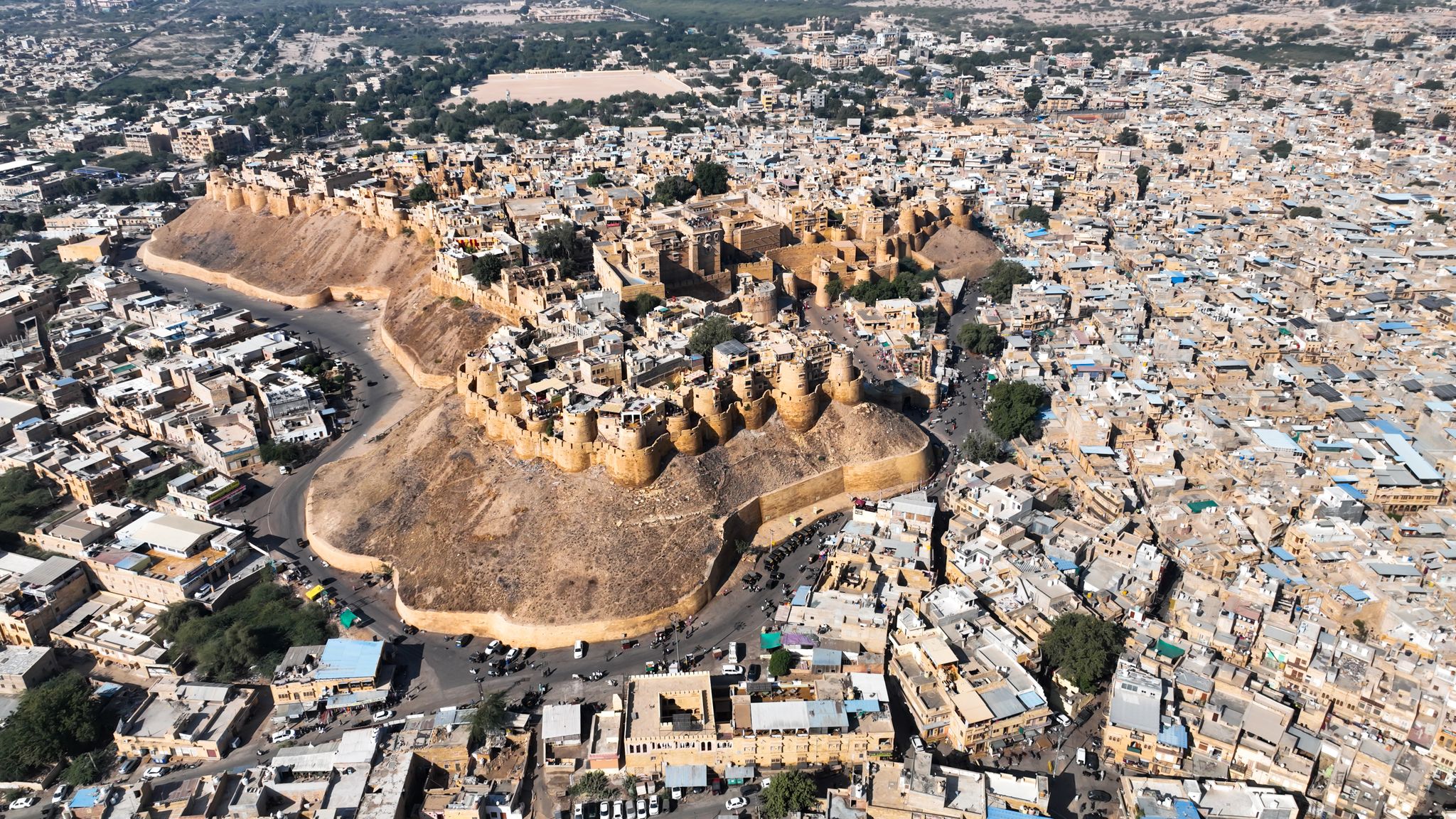
Jaisalmer is built from the same yellow sandstone it stands on, which is why at six in the evening the whole fort looks lit from inside — and why at midday it looks like nothing much at all. Time your first look for the last hour of light. The fort is one of very few in the world still lived in: several thousand people, with shops, homes, temples and plumbing inside the walls. That is what makes it extraordinary and also what is slowly destroying it, because the drainage was never built for modern water use and the bastions are being undermined. Conservationists ask visitors to sleep outside the walls rather than in the fort hotels. It is worth honouring. Patwon ki Haveli is the finest carved stone in the city. The Jain temples inside the fort are quieter and, to my eye, better. For the desert, the choice matters. Sam dunes at sunset is a full circus of camels, jeeps and loudspeakers. Khuri is further out, plainer, and gives you the silence people actually come to the Thar for. November to February. Nights in the desert get genuinely cold — bring more than you think.
The Ranakpur Jain Temple, set in a quiet Aravalli valley, is a 15th-century marble masterpiece dedicated to Adinath, the first Tirthankara. Famed for its forest of 1,444 individually carved marble pillars — no two alike — it stands with Dilwara as the finest marble carving in Rajasthan.
Bikaner gets a fraction of Jaisalmer's and Jodhpur's visitors and is a better city for it. Nothing here is queued. Junagarh, begun in 1589, is unusual among Rajasthan's forts in standing on flat ground rather than a hill, and it was never taken — which is why the painted interiors survived intact. The lacquer ceilings and the gold-leaf Anup Mahal are the reason to come, and the museum has a First World War biplane in it. Inside the old walls the city is a grid of red Dulmera sandstone havelis, the Rampuria cluster being the best of them and most still lived in. Bhujia was invented here. The Karni Mata temple at Deshnoke, thirty kilometres south, is the one with the rats — you go barefoot or you do not go. October to March. April to June sits well over 40°C.
Bundi is what Rajasthan looked like before the tour buses found it, and it is an hour off the Jaipur to Udaipur road that most people never take. The palace above the town is only partly open and partly falling down, and the Chitrashala inside it holds some of the finest surviving Rajput miniature wall painting anywhere — blue-green, crowded with detail, and you will very likely see it alone. Above the palace, Taragarh fort is overgrown and full of monkeys; go up for the view over the lake and the blue houses, and take a stick for the langurs. Raniji ki Baori is the stepwell to see. Bundi has dozens of them, most neglected, and this one is deep, precise and almost always empty. There is very little here in the way of nightlife, shopping or restaurants, and that is the point. Two nights, on foot. October to March. The town is at its best right after the monsoon when the lake is full — by April it draws down and the setting loses a good deal.