.jpg?width=1920)
religious
When it happens
September
Begins on Shukla Chaturthi of Bhadrapada (Aug–Sep), with immersion (Anant Chaturdashi) ten days later. Region: Maharashtra, Goa, Karnataka.
.jpg?width=640)

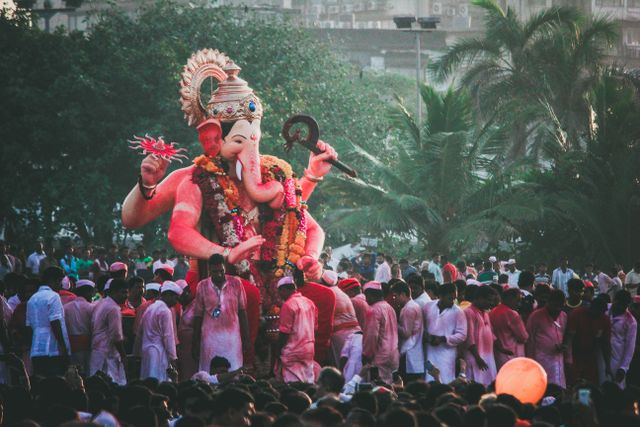
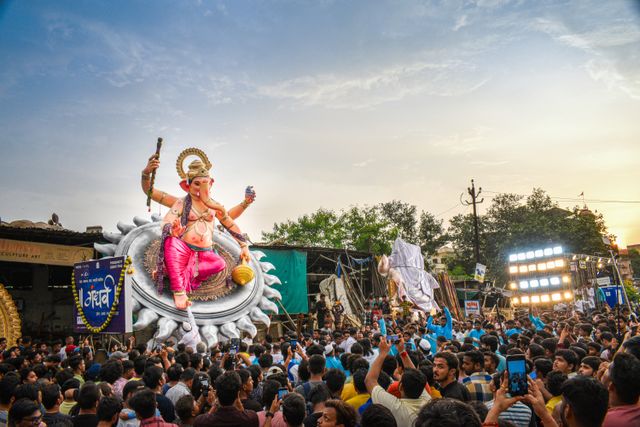


The birthday of Lord Ganesha, the remover of obstacles. Marked by grand clay idols, public pandals and immersion processions, especially in Maharashtra.
The festival commemorates the birth of Lord Ganesha. According to mythology, Goddess Parvati created Ganesha from sandalwood paste to guard her door while she bathed. When Lord Shiva returned and was blocked by Ganesha, Shiva beheaded him in anger. To soothe a grief-stricken Parvati, Shiva replaced his head with that of the first creature facing north—an elephant—and blessed him as the foremost worshipped deity.
Beautiful clay idols of Ganesha are installed in homes and grand public tents (pandals). For ten days, priests perform daily prayers, sing aartis, and offer Ganesha's favorite sweet, 'Modak.' The festival culminates on 'Anant Chaturdashi' with massive, musical street processions where the idols are carried to lakes and oceans for ritual immersion ('Visarjan').
Key specific rituals include 'Prana Pratishtha' (consecrating life into the idol), 'Shhodashopachara' (16-step worship ritual), daily singing of the classic 'Sukhakarta Dukhakarta' aarti, and the dramatic 'Visarjan' (immersion).
The ritual of Visarjan symbolizes the cosmic cycle of creation and dissolution, reminding devotees that all physical forms are temporary, while the divine spirit remains eternal. Ganesha's form itself is highly symbolic: his large ears teach us to listen more, his small mouth to speak less, and his large belly to digest all good and bad experiences in life.
While celebrated since the Satavahana dynasty and popularized by Shivaji Maharaj in the 17th century, it was transformed into a grand public festival in 1893 by nationalist leader Bal Gangadhar Tilak. Tilak used Ganesha as a unifying symbol to bypass British bans on public political gatherings, bridging caste divides and turning devotion into a vehicle for national pride and independence.
Prepare for an overwhelming, high-energy whirlwind of devotion and music. The streets are alive with the thunderous, earth-shaking beats of massive 'Dhol-Tasha' drumming groups. The air is thick with red gulal powder and the sweet smell of steamed modaks. Public pandals are decorated to resemble ancient palaces or temples, housing colossal, Ganesha idols. On the final day, the beaches of Mumbai transform into a sea of humanity, where millions dance, sing, and shed tears of joy, bidding a hopeful farewell to Ganesha with chants of 'Ganapati Bappa Morya!'
Immersion (Visarjan) represents Ganesha returning to his celestial home on Mount Kailash. It symbolizes the natural cycle of creation, life, and dissolution, teaching that God exists in everything and can be worshipped in any form.
The mouse represents desire and ego, which can cause ruin if uncontrolled. Ganesha riding the mouse symbolizes overcoming and taming these baser instincts through wisdom and intellect.
.jpg?width=640)
religious
Bodh Gaya, Sarnath, Kushinagar, Sikkim, Ladakh, and globally across Buddhist nations.

religious
Celebrated extensively across Northern, Western, and Central India, as well as by Hindu communities worldwide.

religious
The sacred Mahamaham Tank in Kumbakonam, Thanjavur district, Tamil Nadu.

religious
Celebrated at the Hemis Monastery, located 45 km southeast of Leh, Ladakh (high-altitude region in Northern India).

religious
Bihar, Jharkhand, Eastern Uttar Pradesh, and by migrant communities.
religious
Across Sikkim, with the absolute cultural and ritual centerpiece performed at the Tsuklakhang Royal Palace Monastery courtyard in Gangtok.
.jpg?width=640)
religious
Basilica of Bom Jesus, Old Goa (Velha Goa), Goa.

religious
Celebrated across India, with major historical celebrations in Pawapuri and Kundalpur (Bihar), the Dilwara Temples near Mount Abu (Rajasthan), and Palitana (Gujarat).